
19.5 Comparing Quantities with Uncertainties#
For various reasons we want a way to compare two or more quantities which have standard uncertainties determined using the GUM framework. For example, if we want to compare different measurement techniques that have been used to determine the same measurand, or if we want to compare different measurands to determine if there is a significant different between them. The GUM itself does not have a prescribed method for comparing quantities with standard uncertainties, so we will consider two techniques from different sources:
the method used in the undergraduate physics lab at UCT [UCompare2]
the method described in the VIM [UCompare1].
Comparing Quantities as Recommended in the Undergraduate Physics Lab at UCT#
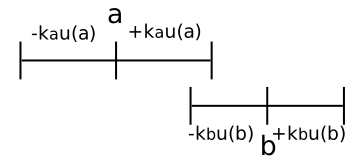
In the Introduction to Measurement in the Physics Laboratory [UCompare2] to compare two quantities it is advised to use the expanded uncertainties of the quantities as coverage intervals, if the intervals overlap then the quantities are said to agree within the given level of confidence.
In other words, consider the quantities \(a\) with standard uncertainty \(u(a)\) and \(b\) with standard uncertainty \(u(b)\). For a chosen confidence level \(p\), the expanded uncertainties can be expressed as \(a \pm k_a u(a)\) and \(b \pm k_b u(b)\) where \(k_a\) and \(k_b\) are the coverage factors used to achieve the confidence level of \(p\). Note that, if the dispersion of \(a\) and \(b\) are both described with the same kind of probability distribution function, then \(k_a = k_b\). If these expanded uncertainty intervals overlap, then the quantities are said to agree within a level of confidence of \(p\), illustrated:
Comparing Quantities As Recommended by the VIM#
In the International vocabulary of metrology (VIM), “2.47 metrological compatibility of measurement results” [UCompare1], to compare two quantities it is advised to take the absolute difference of the the two quantities and determine the combined uncertainty of these quantities. If the absolute difference is less than the expanded uncertainty, then the two quantities are in agreement given the level of confidence.
In other words, consider the quantities \(a\) with standard uncertainty \(u(a)\) and \(b\) with standard uncertainty \(u(b)\). The absolute difference is defined as:
The combined uncertainty of \(d\) (assuming \(a\) and \(b\) aren’t correlated) can be determined using (28):
The two quantities can be said to be in agreement given a confidence level of \(p\) if
where \(k\) is the coverage factor corresponding to \(p\).
Comparing More Than Two Quantities#
If you need to compare more than two quantities, then you can use one of the techniques described above to compare the quantities in pairs. In other words if you have quantities \(a\), \(b\), \(c\) and \(d\); compare each of these in pairs:
Compare \(a\) to \(b\)
Compare \(a\) to \(c\)
Compare \(a\) to \(d\)
Compare \(b\) to \(c\)
Compare \(b\) to \(d\)
Compare \(c\) to \(d\)
Note it is possible for two quantities to have agreement with a third, but not each other; for example: \(a\) could agree with \(b\) and \(b\) could agree with \(c\) but it is possible for \(a\) not to agree with \(c\).
References#
BIPM, IEC, IFCC, ILAC, ISO, IUPAC, IUPAP, and OIML. International vocabulary of metrology — Basic and general concepts and associated terms (VIM). Joint Committee for Guides in Metrology, JCGM 200:2012. (3rd edition). URL: https://www.bipm.org/documents/20126/2071204/JCGM_200_2012.pdf/f0e1ad45-d337-bbeb-53a6-15fe649d0ff1.
Andy Buffler, Saalih Allie, Fred Lubben, and Bob Campbell. Introduction to Measurement in the Physics Laboratory. A probabilistic approach. Department of Physics, University of Cape Town, South Africa and Science Education Group, Department of Educational Studies, University of York, UK, version 3.5 edition, 2009. [Online; accessed 18-February-2020]. URL: http://www.phy.uct.ac.za/phy/people/academic/buffler/downloads/labmanual.