
19.2 Type B Uncertainty Evaluation#
Type B uncertainty evaluation is used when the best approximation of a measurand is not determined from repeated observations. The standard uncertainty is deterimend by “scientific judgement” based on the information that is available; this could be:
previous measurement data
experience with or general knowledge of the behaviour and properties of relevant materials and instruments
manufacturer’s specifications of instruments
data provided in calibration and other certificates
uncertainties assigned to reference data taken from handbooks
Even more than for Type A, there is no “one-size-fits-all” solution.
Quoting Uncertainties from Other Sources#
Sometimes you will need to quote best approximations of the measurand and uncertianties from an external source. This source didn’t need to follow the GUM framework, as if it is clear enough how the uncertainty was obtained, then this uncertainty can be converted to the GUM framework. This conversion must be performed on a case-by-case basis.
Uniform Probability Distribution#
When the only information we know about the measurement is the range of possible values for the measurand around the best approximation \([x - a, x + a]\), then we may assume a uniform / rectangular PDF (every value of in the range is equally likely):
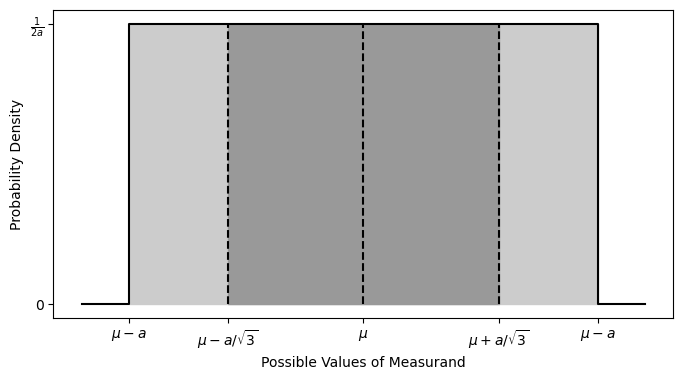
which has a variance of
and thus, the standard uncertainty is:
This PDF is often used when taking readings directly off of digital displays, and we will often use it with our numerical error estimations.
Triangular Probabilty Distribution#
If we know the range of possible values for the measurand around the best approximation \([x - a, x + a]\) and that probabilty of this drops-off at the boudaries, then we may use a triangular PDF (likelyhood is maximum at the center and zero at the boundaries):
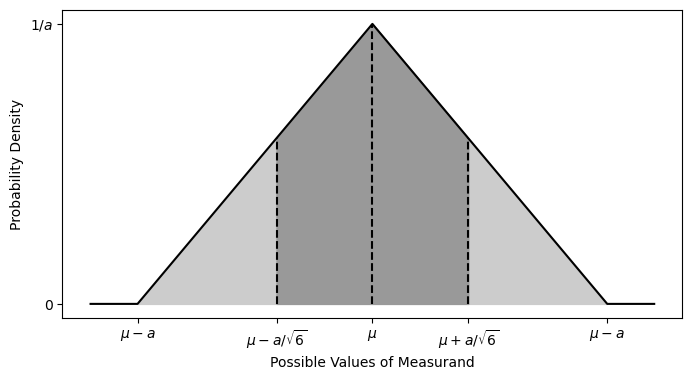
which has a variance of
and thus, the standard uncertainty is:
This PDF is often used when taking readings from analogue displays (e.g. when measuring lengths with a ruler).